
 Brochure


Commercial Building on Your Plot in Bangalore: Rent vs Self-Use, Which Earns More?
25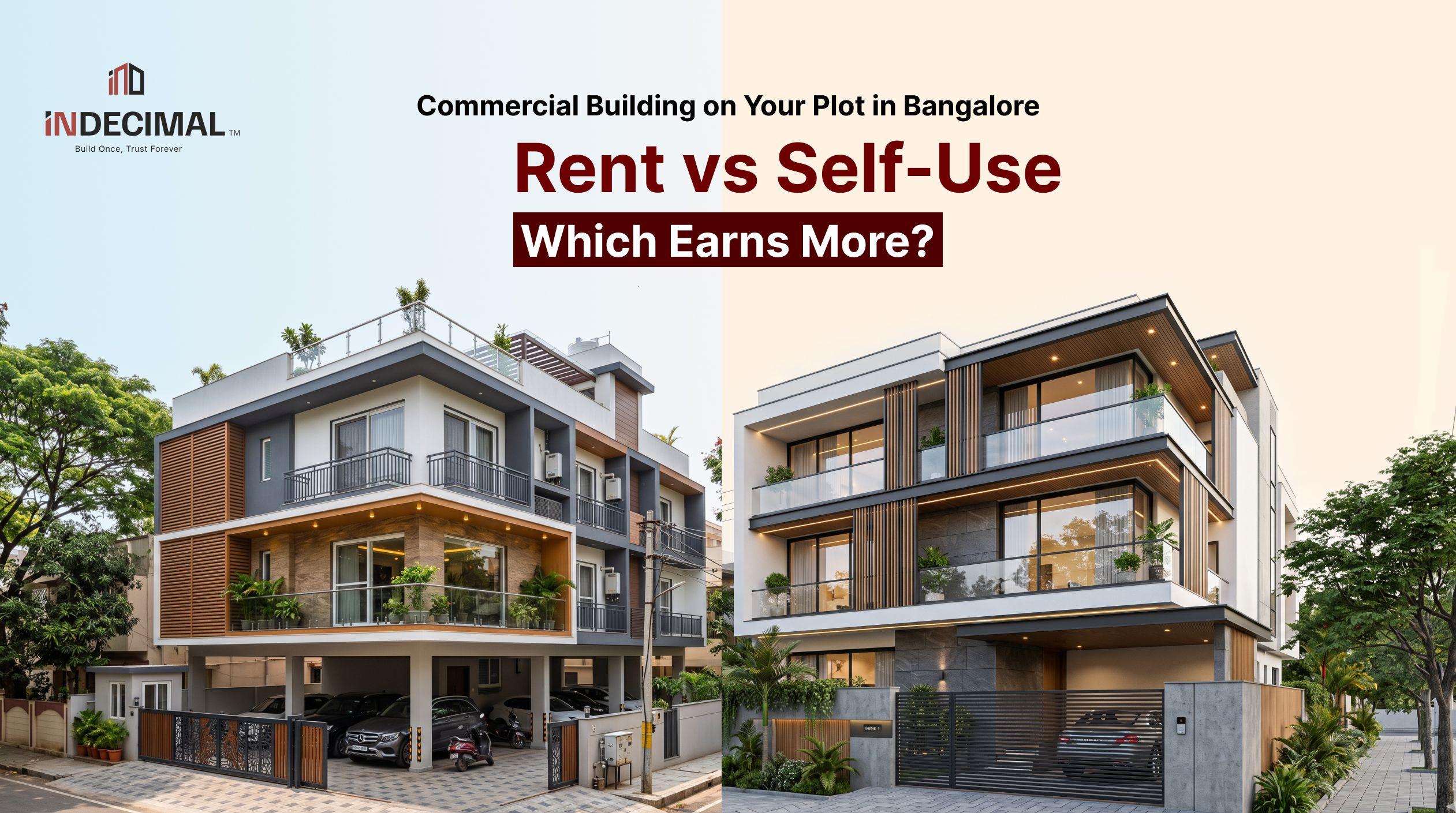
You own a plot in Bangalore and you're considering a commercial building instead of a house. The next question is the one that decides the whole design: will you rent it out, or run your own business from it? Most owners answer this emotionally ("I'll figure it out later") and end up with a building that suits neither purpose well.
This guide compares the two paths with realistic numbers, shows when each one earns more, and explains why the best answer for many plot owners is a third option.
Quick Answer for Plot Owners
Renting usually produces more visible cash flow per rupee of construction cost. Self-use produces value that is harder to see: the rent you stop paying, and the control you gain over your premises. Which earns more depends on one question: how much rent would you pay for the same space if you didn't own it?
What Commercial Property Typically Yields in Bangalore
Commercial rental yields in Bangalore generally fall in the range of 5 to 9 percent a year on property value, with offices around 6 to 8 percent and retail shops around 5 to 7 percent. Micro-markets differ: corridors such as Whitefield, Electronic City, and Sarjapur Road often sit toward the upper end, while premium locations like Koramangala can show lower yields because property values are higher.
Rents vary even more. Office rents run from roughly Rs 60 to Rs 95 per sq ft per month in parts of North Bengaluru to Rs 160 to Rs 250 in central business districts. Retail rents for ordinary shops often sit around Rs 100 per sq ft per month on average, with showrooms and prime frontage commanding more. Treat these as indicators and check live listings on your own street before you plan.
Option 1: Build to Rent
An Illustrative Example
Take a 30x40 plot built as ground plus two floors, with about 1,000 sq ft per floor, so roughly 3,000 sq ft of rentable area.
| Floor | Use | Area | Assumed Rent per Sq Ft | Monthly Rent |
|---|---|---|---|---|
| Ground | Retail | 1,000 sq ft | Rs 90 | Rs 90,000 |
| First | Office or clinic | 1,000 sq ft | Rs 55 | Rs 55,000 |
| Second | Office | 1,000 sq ft | Rs 50 | Rs 50,000 |
| Gross rent | Rs 1.95 lakh |
After allowing for vacancy (say 8 percent) and owner costs such as property tax, repairs, and common-area upkeep (say 10 percent), the net comes out around Rs 1.6 lakh a month. Construction for this kind of building could plausibly fall in the range of Rs 65 lakh to Rs 85 lakh depending on specification, so the yield on construction cost would sit in the region of 20 percent a year before land value. If you include the land at market value, the yield drops to the 5 to 8 percent range quoted above.
These numbers are illustrative. Your rents, vacancy, and construction cost will differ, so replace them with quotes for your own location. If you're also weighing a per-bed income model instead of leasing to businesses, our guide to PG building construction in Bangalore breaks down the cost and return for plot owners.
What Renting Costs You in Complexity
You become a landlord. That means tenant selection, lease agreements, deposits, maintenance, and occasionally disputes. Vacancy between tenants is real, and a poorly designed building can sit empty for months.
There is also a tax point. If your annual rental income from commercial property crosses the GST registration threshold, currently Rs 20 lakh a year in most states, you generally have to register for GST and charge 18 percent on rent. In the example above, gross rent is about Rs 23 lakh a year, which crosses that line. Speak to a chartered accountant about how this works for your situation, including whether input credit on construction is available to you.
Option 2: Build for Self-Use
How the Math Changes
If you run a business that currently pays rent, building your own premises converts that rent into equity. Suppose you pay Rs 1 lakh a month for 2,000 sq ft today. If you build a comparable space for Rs 60 lakh to Rs 70 lakh on land you already own, your effective return is the rent you no longer pay, roughly Rs 12 lakh a year, plus any appreciation. You also avoid annual rent escalations and the risk of a landlord not renewing your lease.
What you give up is flexibility and liquidity. Capital is tied up in a building rather than in your business, and your business risk and property risk now sit in the same place.
Where Self-Use Makes Sense
If your business needs a custom layout that is hard to find on the rental market, such as a clinic, a showroom, or light manufacturing, owning gives you design control. If you expect to stay in the same location for ten years or more, the rent you save compounds. And if your business is stable enough that you won't need the capital elsewhere, owning removes a recurring cost.
Rent vs Self-Use at a Glance
| Factor | Build to Rent | Build for Self-Use |
|---|---|---|
| Income | Visible monthly rent | Rent saved, not visible as income |
| Effort | Landlord duties, tenant management | Operate your own business |
| Flexibility | Can change tenants or use | Layout built around your needs |
| Risk | Vacancy and tenant default | Business risk tied to the property |
| Tax | GST on rent above threshold | Different treatment, consult a CA |
| Best when | You have no business needing the space | You pay significant rent today |
The Third Option: Hybrid
For many plot owners the strongest design is a hybrid: occupy one floor for your own business and rent the rest. The ground floor, which commands the highest rent and best visibility, can serve your business or be rented, while upper floors go to office or clinic tenants.
A hybrid reduces your rent cost to zero, gives you rental income on the other floors, and spreads risk. It also gives you an exit path: if your business needs change, you can rent the floor you occupied.
The design requirement is that each floor must work independently. That means separate entrances where possible, separate electricity meters, independent water connections, and layouts that can serve more than one kind of tenant.
Design Decisions That Affect Income
Flexible floor plates. Large open floors that can be partitioned suit more tenant types than rigid layouts.
Separate meters per floor. This avoids billing disputes and makes each unit independently lettable.
Ground-floor frontage. Visible frontage, adequate width, and easy access command the highest rent. Parking has a major effect on retail and clinic tenants.
Services sized for commercial load. Electrical capacity, plumbing, and HVAC provisions for offices and clinics are heavier than for houses. A cost-saving shortcut here limits who can rent the building later. Our guide to office construction and fit-out covers the services load in more detail.
Lift and staircase planning. Buildings above ground plus two floors often need a lift to stay lettable, and the staircase position affects how floors can be divided.
Compliance Before You Build
Commercial use has stricter requirements than residential, and the plot's status matters from the start.
Khata and land use. You need a valid e-Khata linked to the plot to get a building plan sanctioned, and the plot's land use must allow commercial construction. See our guide to A Khata, B Khata and e-Khata before you commission drawings.
Road width and zoning. Permissible commercial use, setbacks, and floor area depend on the road width and zoning of your plot. Confirm these with the Greater Bengaluru Authority before you finalize a design.
Fire and safety. Fire safety provisions depend on building height and use, and some buildings need a fire NOC. Plan these into the drawings rather than retrofitting.
Occupancy certificate. Tenants, banks, and licence authorities will usually ask for it.
The Cost Risk Is Different for Commercial
An overrun on a house is annoying. An overrun on an income-producing building directly reduces your return and delays your first rent. This is why an itemized BOQ and a clear understanding of why final bills differ from quotes matter even more for a commercial project.
Frequently Asked Questions
Is commercial construction more expensive than residential?
Usually, per square foot, yes. Commercial buildings need heavier electrical and plumbing provisions, larger structural loads in some cases, fire safety provisions, and often a lift. Get a quote against your own drawings.
Does commercial property give a better return than a house?
Commercial yields in Bangalore are generally higher than residential rental yields, but vacancy periods can be longer and tenant fit-outs are more specialised. Return depends on location and tenant demand.
Can I build a commercial building on a residential plot?
Not automatically. Land use and zoning must permit it, and converting use involves approvals. Verify with the authority before you design.
Do I have to pay GST on rent from my commercial property?
If your aggregate annual rental income crosses the GST registration threshold, currently Rs 20 lakh in most states, you generally must register and charge 18 percent GST. Consult a chartered accountant for your specific case.
Is a hybrid model worth it?
For many plot owners, yes. It cuts your own rent to zero, earns income from the other floors, and keeps your options open. It needs a design where each floor can operate independently.
Should I fit out the building before renting it?
Usually you hand over a warm shell with basic services and let the tenant fit out. The more finished you make it, the higher the rent can be, but the more you invest and the narrower your tenant pool becomes.
Decide the Use Before You Design
Every major design choice, from floor plate to meters to frontage, depends on whether the building will be rented, used, or both. Deciding that after construction means paying to change it.
Indecimal builds commercial buildings on plots across Bangalore, starting from your intended use and compliance requirements, with an itemized BOQ before you sign. If you have a plot and want to compare what it could earn as a rental building versus a space for your own business, send us the dimensions and location and we'll walk you through both options.
Planning a Commercial Building on Your Plot?
We’ll design it around your intended use, rental or self-use, before you commit.