
 Brochure

Construction Estimate vs Fixed Price Contract: What's the Difference?
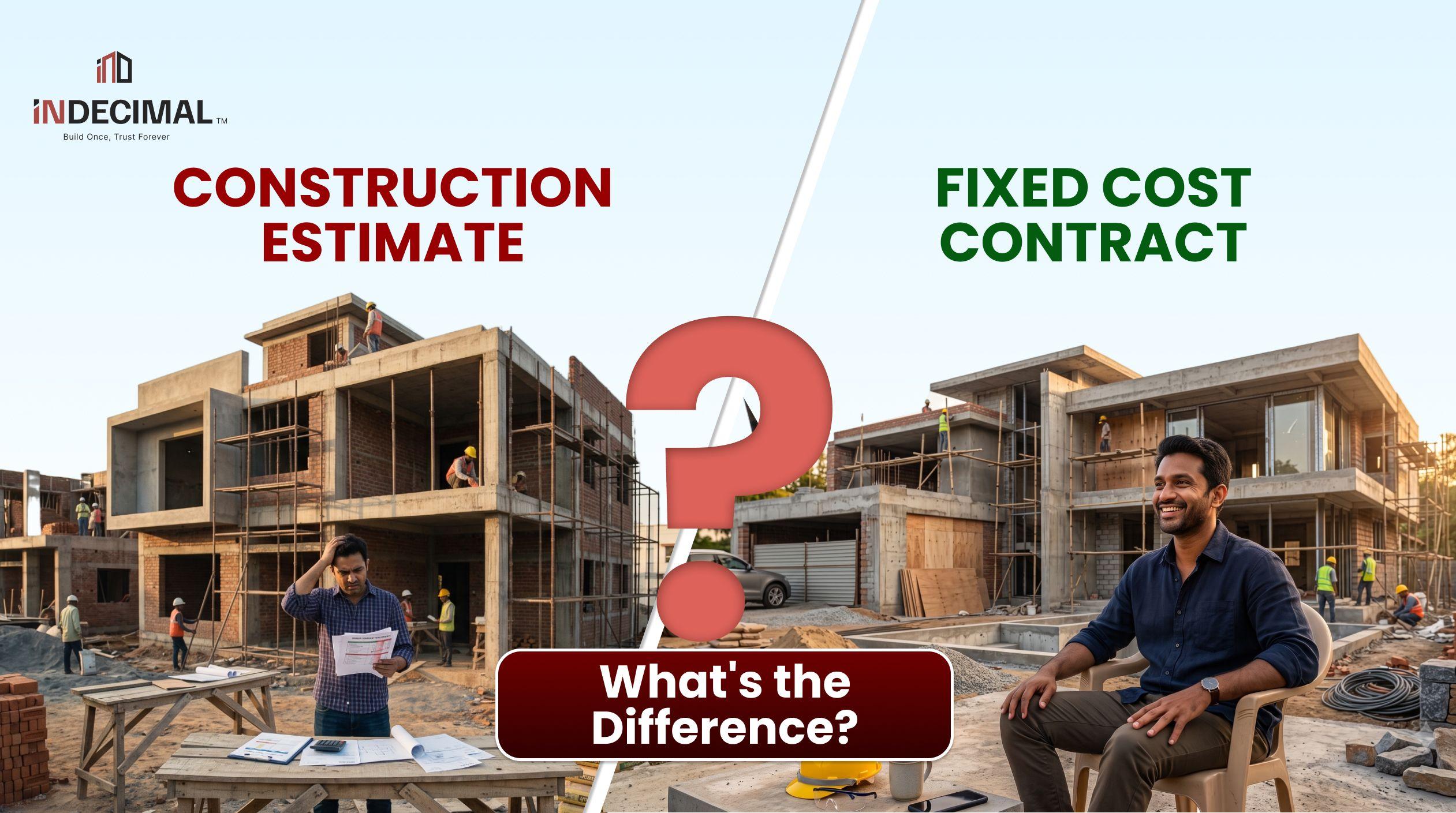
Somewhere in almost every construction dispute in Bangalore, there's a client holding a piece of paper they believed was a fixed price and a contractor holding the same piece of paper, calling it an estimate. Both parties aren't lying. They're using two words that sound similar, get used loosely in everyday conversation, and mean fundamentally different things in a construction contract. That gap is where budgets blow up, timelines slip, and relationships between client and contractor sour.
This is the page we wanted to exist before we needed to send it to a client mid-argument: a clear, honest explanation of what an estimate actually is, what a fixed price contract actually is, and why the difference matters more than almost anything else you'll negotiate before construction starts.
What a Construction Estimate Actually Is
A construction estimate is a projection. It's the contractor's best professional judgment of what a project will cost, based on the information available at the time: drawings (often preliminary), a site visit, prevailing material and labor rates, and assumptions about ground conditions, approvals, and scope that haven't been fully finalized yet.
Critically, an estimate is not a promise. It's built on assumptions, and if those assumptions turn out to be wrong, the actual cost can move, sometimes significantly. A good estimate will state its assumptions explicitly (soil conditions assumed normal, no rock excavation anticipated, material specifications as per a stated brand list). A poor one won't, which is exactly how "the estimate was 40 lakh and the final bill was 58 lakh" disputes happen: not necessarily through dishonesty, but through unstated assumptions that didn't hold.
Estimates are appropriate, and even standard practice, at the early stage of a project when design isn't finalized. What they are not appropriate for is being treated as a binding number you can hold a contractor to without any mechanism for adjustment.
What a Fixed Price Contract Actually Is
A fixed price contract (also called a lump sum contract) is a binding agreement where the contractor commits to completing a clearly defined scope of work for a specific, agreed price, regardless of the contractor's actual cost to deliver it. If material prices rise or the job takes longer than planned, that risk sits with the contractor, not the client, provided the scope hasn't changed.
This is the crucial trade: a fixed price contract only works as "fixed" if the scope behind it is genuinely fixed too. A price is only as reliable as the drawings, specifications, and scope of work it was calculated against. This is why a legitimate fixed price contract requires finalized architectural drawings, a detailed specification sheet (brand and grade of every major material), and structural and MEP drawings, not a rough floor plan and a verbal description of finishes.
A fixed price quoted against incomplete drawings isn't really a fixed price. It's an estimate wearing a fixed price contract's name, and the gap between the two surfaces later as change orders.
The Core Difference: Who Carries the Risk
This is the single most useful way to think about the distinction. In an estimate-based arrangement, cost risk sits largely with the client: if costs run higher than projected, the client typically bears the difference. In a genuine fixed price contract, cost risk sits largely with the contractor, in exchange for which the contractor usually prices in a margin to cover uncertainty, meaning a fixed price contract is often quoted somewhat higher than a comparable cost-plus estimate for the same scope, because the contractor is being paid to absorb the risk rather than pass it through.
Neither structure is inherently better. The right choice depends on how well-defined your scope is, how much budget certainty you need, and how much risk premium you're willing to pay for that certainty.
Other Contract Structures You'll Encounter
Estimate-based and fixed price aren't the only two options. In practice, Bangalore contractors use a handful of structures, often for different phases of the same project.
Cost-plus contracts bill the client for actual costs incurred (materials, labor, subcontractors) plus an agreed contractor fee, typically a percentage markup. This gives full cost transparency and works well when scope is likely to evolve, but it removes the client's budget ceiling unless capped.
Guaranteed Maximum Price (GMP) contracts are a hybrid: the client pays actual costs plus a fee, similar to cost-plus, but with a contractually agreed ceiling the total won't exceed. If actual costs come in under the ceiling, the client benefits (sometimes split with the contractor via a savings-share clause); if they'd exceed it, the contractor generally absorbs the difference, provided scope hasn't changed. GMP is often the most balanced structure for clients who want cost transparency without open-ended risk.
Unit price contracts price the project per unit of measurable work (per square foot of flooring, per running foot of cabling, per cubic meter of excavation) rather than as a single lump sum. This works well for projects where total quantities are uncertain at the time of signing but unit rates can be reliably fixed, common in civil and infrastructure-heavy scopes.
| Contract Type | Who Bears Cost Risk | Best For | Watch Out For |
|---|---|---|---|
| Estimate (non-binding) | Client | Early-stage budgeting, pre-design | Being treated as a binding number without an adjustment mechanism |
| Fixed price / lump sum | Contractor | Fully finalized drawings and specs | "Fixed" pricing quoted against incomplete drawings |
| Cost-plus | Client (uncapped) | Renovation or evolving scope | No ceiling means no real budget certainty |
| GMP (Guaranteed Maximum Price) | Contractor (above ceiling) | Clients wanting transparency with a cap | Ceiling set too high to be meaningful, or vague savings-share terms |
| Unit price | Shared, by measured quantity | Civil/infra work with uncertain quantities | Ambiguous measurement method, disputes over quantity verification |
Why This Confusion Costs People Money
The most common and expensive mistake in Bangalore residential and commercial construction isn't picking the wrong contract type. It's not realizing which one you actually have. A client who believes they've signed a fixed price contract, but actually signed off on an estimate with a rough scope, will be blindsided by change orders that the contractor sees as legitimate scope clarifications and the client sees as broken promises.
The fix isn't complicated, but it does require asking directly, in writing, before signing anything: is this number binding regardless of my final cost to deliver, or is it an estimate that can move if conditions or scope change? A contractor who can't answer that question clearly is a contractor you should be cautious about signing with at all.
Change Orders: How They Work Differently Under Each Structure
Under a fixed price contract, a change order is the only legitimate way the price moves, and it should require the client's written approval before any additional cost is incurred. This is the entire point of a fixed price contract: predictability, protected by a formal change process.
Under an estimate-based or cost-plus arrangement, cost movement doesn't require a formal change order in the same way, because the number was never a binding commitment to begin with. This is exactly why estimate-based projects need frequent, proactive cost updates from the contractor rather than a single number quoted at the start and left unrevisited until the final bill.
A well-run project, regardless of contract type, has a defined process for how scope changes are priced, approved, and documented. The absence of that process, not the contract type itself, is usually the real source of disputes.
Red Flags to Watch For
A "fixed price" quoted before drawings are finalized. If the architectural, structural, and MEP drawings aren't complete, no contractor can genuinely fix a price against them. What you're holding is an estimate with fixed-price branding.
No specification sheet attached to the price. A price without a stated brand and grade for flooring, sanitaryware, electrical fittings, and finishes leaves the contractor free to substitute cheaper materials and still technically meet "the contract."
Verbal assurances instead of a written change order process. "Don't worry, we'll sort out any extra costs later" is not a change order process. It's an invitation to a dispute.
An estimate with no stated assumptions. If a contractor hands you a number with no explanation of what it assumes about site conditions, approvals, or material rates, you have no way to know what would cause that number to change.
A cost-plus arrangement with no ceiling at all. Cost-plus without a cap can be entirely legitimate for genuinely evolving scope, but it should come with regular, itemized cost reporting, not a single bill at the end.
A Practical Framework for Deciding Which Structure Fits Your Project
Ask yourself three questions before choosing a contract structure:
How finalized is my design?
If drawings and specifications are complete and unlikely to change, a fixed price contract is workable and gives you the most budget certainty. If design is still evolving, insisting on a fixed price against incomplete drawings mostly just shifts risk into future change orders, not away.
How much budget certainty do I actually need?
If a firm ceiling matters more to you than optimizing for the lowest possible cost, a fixed price or GMP structure serves that priority better than cost-plus.
How much do I trust the contractor's cost transparency?
Cost-plus and GMP structures depend on the contractor sharing genuine cost documentation. If that transparency isn't something you're confident you'll get, a fixed price contract removes the need to trust it, since the price is fixed regardless of the contractor's actual costs.
There's no universally "better" answer. A well-defined residential build with finalized drawings is usually well served by a fixed price contract. A renovation project with unknowns behind existing walls is often better served by cost-plus with a cap, or a GMP structure, precisely because nobody, including the contractor, can price unknowns with certainty.
How This Plays Out on an Actual Bangalore Project
In practice, most well-run projects use more than one structure across their lifecycle. Design and approvals are often handled on a fee basis (a fixed professional fee independent of construction cost). Once drawings and specifications are finalized, the construction phase itself moves to a fixed price or GMP contract, since that's the stage where scope is genuinely locked down. Any subsequent client-requested changes are then priced and approved individually as formal change orders, rather than folded silently into a revised "estimate" with no paper trail.
This layered approach is also why an end-to-end construction service with a single accountable contractor tends to produce fewer disputes than a project split across separate design and construction vendors: the handoff from estimate to fixed price happens within one contractual relationship, with one party accountable for making sure the fixed price is actually based on finalized scope, rather than two vendors each pointing at the other when the numbers don't reconcile.
Frequently Asked Questions
Is a "quotation" the same as a fixed price contract?
Not necessarily; the word alone doesn't tell you which it is. A quotation can be binding or non-binding depending on what it explicitly states. Always check whether it says the price is fixed against a defined scope, or whether it's presented as indicative and subject to change.
Can a fixed price contract ever change?
Yes, but only through a formal change order tied to an actual scope change (a client-requested addition, a design revision, or an unforeseen site condition explicitly excluded from the original scope). A fixed price contract shouldn't move due to the contractor's own cost overruns on the originally agreed scope.
Is cost-plus always more expensive than fixed price?
Not necessarily, and sometimes the opposite. Fixed price contracts usually include a risk premium the contractor charges for absorbing uncertainty, so if a project runs smoothly with no surprises, cost-plus can end up cheaper. The trade-off is that cost-plus offers no ceiling unless a GMP structure is used.
What's the minimum I should get in writing before agreeing to a fixed price?
Finalized architectural, structural, and MEP drawings, a detailed specification sheet naming brands and grades for all major materials, a milestone-based payment schedule, and a written change order process. Without all four, a "fixed price" isn't fully protected.
Should I ever accept a fixed price quote based on preliminary drawings?
Generally, no. A price fixed against preliminary drawings usually just delays the real cost conversation to the change order stage, where it tends to be more contentious, not less.
Final Thoughts
An estimate and a fixed price contract solve different problems, and the confusion between them, not the structure of either, is what causes most construction disputes in Bangalore. Before signing anything, get clear, in writing, on which one you actually have: a projection built on assumptions that can move, or a binding commitment tied to a genuinely finalized scope. That single clarification, more than any negotiation over the number itself, is what protects your budget and your relationship with your contractor through the life of the project.
If you're planning a project in Bangalore and want a contract structure that actually matches your scope and risk tolerance, Indecimal works through this exact conversation with clients before construction starts, not after a dispute forces it. You can compare project packages here or read our complete guide to commercial construction in Bangalore.
Not Sure If Your Quote Is an Estimate or a Fixed Price?
We assess your scope and drawings before you sign anything.